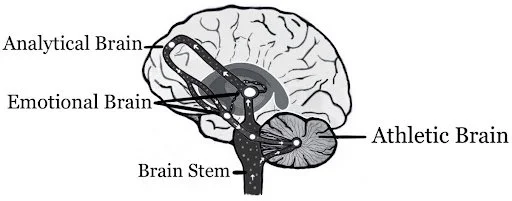
For athletic purposes, your brain is divided into three sections…
But first, let’s discover which part of the brain is in charge of your athletic performance…
And it is NOT what you THINK!
According to recent Harvard studies, 86 billion neurons are distributed across three regions: the cerebellum, the cerebral cortex, and the brainstem.
Cerebellum - 72 billion neurons (84% of total neurons)
Cerebral Cortex - 13 billion neurons (15% of total neurons)
(8% Analytical Brain, 7% Emotional Brain)
Brainstem - 1 billion neurons (1% of total neurons)
To clarify, the part of the brain responsible for analytics and conscious thought contains approximately 6.8 billion neurons, which accounts for about 8% of the brain's total neurons. This relatively small group of neurons processes conscious thoughts related to learning, skill development, problem-solving, working memory, and pain perception.
In the heat of an athletic moment…
The remaining 92% of your brain (to include the emotional brain), particularly the 72 billion neurons in your athletic brain, supports application of skills, beneficial emotions, movement, sensory processing, and motor skill use at a subconscious level.
The question is… Will you let 8% of your brain get in the way of the remaining 92%?
Analytical Brain - Cerebrum
(Conscious Processing - “Mindfullness”)
(8% of the total number of neurons)
This substantial part of your brain, which accounts for 83% of its total mass but only 8% of all neurons, is responsible for the "how-to figure it out” analytics during skill development, learning, attention, and practice. It also drives the inspired emotional motivation of the “want” and curiosity to solve problems. Your analytical brain includes four key areas that regulate cognition, attention, awareness, and consciousness…
Frontal lobe processes complex thinking, decisions, planning, logic, and reasoning
(Your competitive gene has a significant impact on this part of the brain.)
Parietal lobe processes senses such as touch, taste, and temperature
Temporal lobe processes sound, language, recognition, memory, and objects
Occipital lobe processes light and visual perceptions of shapes and movement
(The occipital lobe has the strongest connection to the athletic brain.)
Emotional Brain - Midbrain
(Subconscious Processing)
7% of the total number of neurons
The midbrain, often referred to as the "emotional brain," is the smallest brain region, accounting for approximately 6-7% of total brain volume. It regulates emotional responses and functions, including sleep, hormone production, energy balance, metabolism, and electrolyte balance. The midbrain processes sensory information from sight, sound, touch, thirst, and appetite, including "emotional” eating.
Physical and sensory input triggers emotional responses as it moves downward from the top of the brain toward the brainstem and the athletic brain. This input also provides significant behavioral flexibility, encompassing emotions such as happiness, joy, anticipation, curiosity, trust, surprise (both positive and negative), disgust, anger, fear, and sadness, as well as primal emotions.
Your emotional flexibility, known as the cognitive control network, enables you to observe events and objects both within and outside your environment. This flexibility is vital for emotional discernment, helping you distinguish between positive and negative, good and bad, winning and losing, safe and harmful, and love and fear.
Under specific conditions, your emotional brain becomes an asset for proper and better use of your Athletic Brain as you convert emotional pressure into performance fuel known as “future memory” befor the event and “mental time travel” during the event.
Athletic Brain - Cerebellum
(Subconscious Processing - “Mindlessness”)
85% of the total number of neurons
Your athletic brain - cerebellum (Latin for “little brain”) operates subconsciously to coordinate movements and automatic complex skills. While your Analytical Brain performs with conscious and “mindful” thoughts, your Athletic Brain operates subconsciously with more of a “mindless” approach and is located at the back of the brainstem, ideally as far from your analytical brain as possible. In fact, it isn't even directly connected to your analytical or emotional brain. Picture your athletic brain encased in a protective bubble, isolated from all analytical and harmful emotional information. Any data from your analytical and emotional brain must pass through the brainstem and the Locus Coeruleus, known as the protective gatekeeper, before reaching your athletic brain. (If its not “mission critical,” most of the information gets blocked.)
The “little brain” shouldn’t be underestimated. Even though it makes up only 10% of the brain’s size, it involves the use of 85-92% of all neurons that operate quietly in the background with subconscious - “mindless” processing for fine-tune balance, posture, and motor control enabling “mindless” muscle movement for all athletic performance.