Let’s overlook the poor grammar of “ more better than good” and appreciate its truth as every choice falls within two categories…
GOOD vs. harm
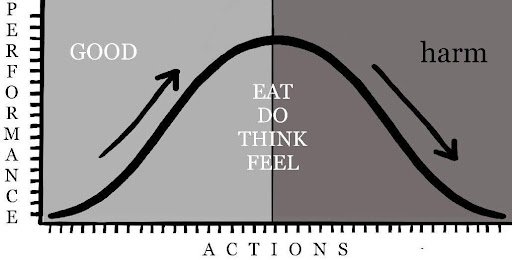
More BETTER than good…
to become more human.
(reaching peak performance)
More HARM than good…
to be less human.
(???)
Figure it Out and the Four Stages of Learning are vital day-to-day tools…
Stage one: You don’t know what you don’t know. (Solution: Know it!)
Stage two: You know what you don’t know. (Solution: Learn it!)
Stage three: You work at what you don’t know. (Solution: Fix it!)
If you don’t fix it yourself, your body will fix it for you,
and you may not like the results…
harm shows up as bad pain.
Similar to Vitamin E (from Day 13), recent research shows that caffeine can do more harm than good. In 2025, an NCAA National Championship team forfeited its title after an athlete tested positive for caffeine levels exceeding the 500-milligram limit, which is considered an illegal substance.
Unfortunately, due to genetic differences, some individuals metabolize caffeine less efficiently than others. Without the ability to metabolize even small amounts of caffeine, it remains in the system for up to 10 hours, causing more harm than good. And here’s the most challenging part: it’s likely that the athlete would have performed better without the caffeine.
According to the study “Caffeine, CYP1A2 Genotype, and Endurance Performance in Athletes” (Journal of Medical & Science in Sports & Exercise), a CYP1A2 genotype is associated with a 13.7% reduction in cycling performance when caffeine is present.
Your DNA (Warrior or Become the Warrior) also determines the amount and type of protein and amino acids. Your DNA also determines whether you should follow an Animal-based or Plant-based diet.
Your FADS1 and FADS2 genes will reveal how your body processes and converts specific nutrients from plant-based foods or from animal-based foods and the presence of omega-3 and omega-6 fatty acids. If (and only if…) you have the “vegetarian gene” variation of these genes, you can easily follow a plant-based diet. But if you do not have the “vegetarian gene,” it is highly recommended that you follow an animal-based diet.
The genes that influence plant-based or animal-based diets are determined by the global distribution of ancestry, where access to animals or plants was the primary food source. For example, India and certain parts of Africa had great access to plant-based foods, which led to a higher percentage of people with the “vegetarian gene.”
(Side note: While this information is an oversimplification for quick attention, the book breaks the information down in greater detail.)
“Let food be thy medicine and medicine be thy food”
-Hippocrates